Biophilic Lighting: Bringing Nature into the Room
Biophilic lighting is an approach to connecting an interior with nature through light. For us, that connection begins with observed forms, the character of materials and the patterns a light brings into a room.
Begin with the nature already present
Notice how daylight moves through the room, the shapes outside the window and the materials you touch every day. Those observations can guide the artificial light rather than being replaced by it. A pendant is one part of that wider relationship.
Our guide to choosing pendant lights begins with the room's purpose and proportions. A nature-inspired form still needs to fit the ceiling, furniture and practical uses of the space.
Nature-inspired lighting: look closely at the form
Flax draws on the spreading leaves of harakeke. Its shallow form offers a broad presence without the depth of a sphere. Coral explores a geometric structure found in nature, repeated into an open volume.
Cloud brings an irregular outline inspired by clouds over Pacific islands. Cloud Small is 1250 mm wide, 1250 mm long and 450 mm high, so give this broad form a generous space. These lights are different interpretations, not a demand for every object in the room to look like a leaf or flower.
Choose one form with a clear relationship to the room. Let other surfaces and objects retain their own character. The connection often becomes stronger when it has space around it.
If your room cannot hold Cloud’s breadth, consider Navicula Small: 570 mm wide, 1440 mm long and 200 mm high. Inspired by microscopic diatoms, it offers a narrower, elongated form with a soft upward ambient glow. Allow for its length and plan separate task lighting where you need it.


Biomimicry: learning from how nature builds
Biomimicry means learning from the way nature makes things: the geometry of a shell, the structure of a leaf, the arrangement of tiny cells. In lighting it can show in how a form is built as much as in how it looks.
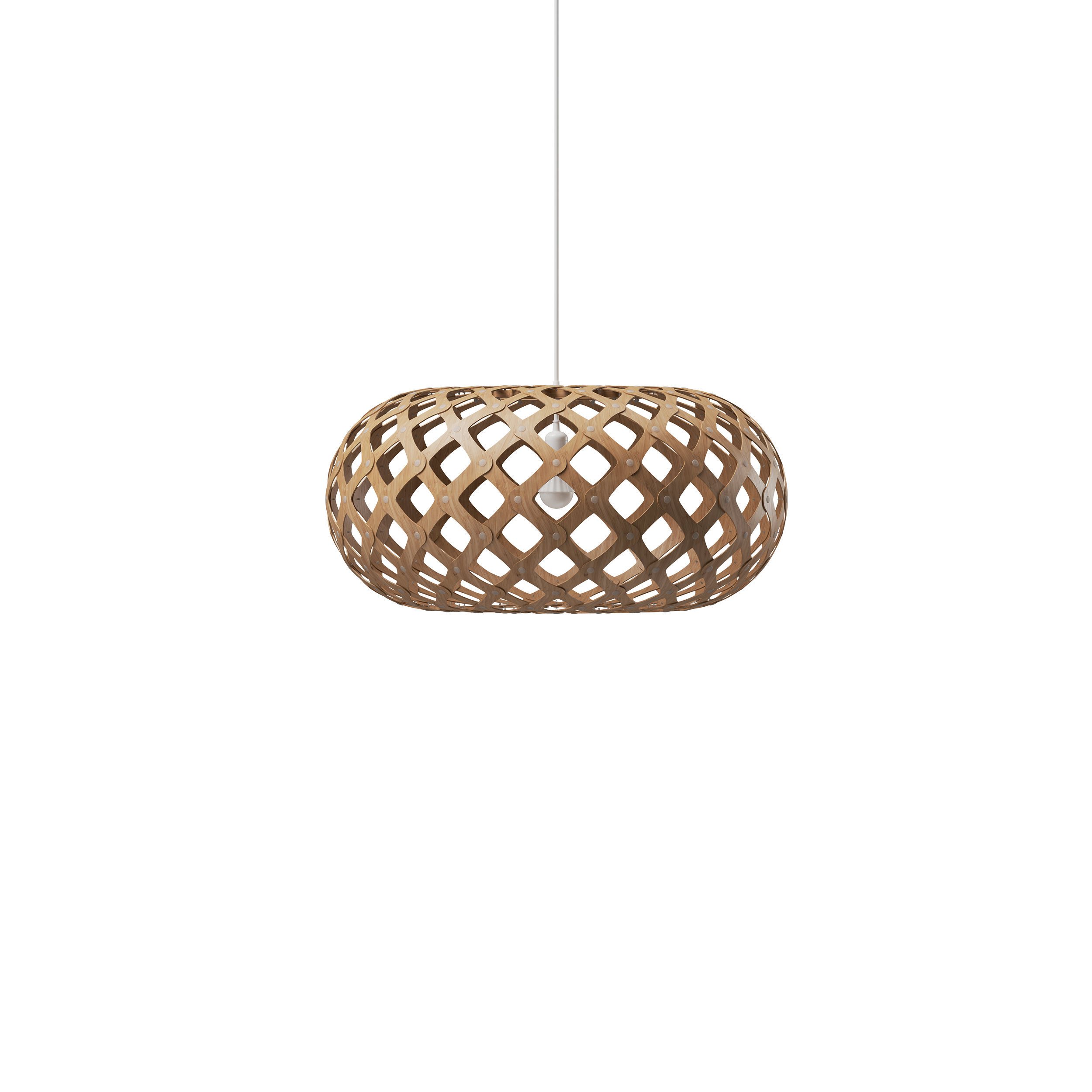
Our Coral repeats one component 60 times to make its geometric volume. Kina interweaves bamboo pieces into a rounded shell. Navicula follows the elongated outline of microscopic diatoms. In each, small repeated parts make an open structure, and that structure becomes the pattern the light carries onto the room.
Biophilic lighting design and materials
A material can remain visible as part of the design. We use thin bamboo components to build an open structure, so you can see how the form comes together.
Kina takes its form from a sea urchin shell David saw frozen under Antarctic ice in 2005. Its interwoven bamboo pieces make a rounded, open shade in widths of 440, 600, 800, 1000 and 1400 mm. Nature gives us the starting point; making the form from small repeated parts gives it its character.
We are a certified B Corp, and our approach to materials and making includes Environmental Product Declarations for our designs. That care belongs alongside the pleasure of living with the light.
Make room for daylight
Look at the proposed light from the places where you spend time. Does it sit comfortably beside a window? Does it interrupt a view you value? An open shade may let the room remain visible through it, but its silhouette still changes the composition.
Use a full-size outline to test the width and height. The size guide gives a practical method. Check the room at more than one time of day, because the background behind the light changes.
Let shadow become part of the evening
Patterned shades bring their structure onto nearby surfaces. The bulb's finish and internal arrangement, the distance to a wall and the other lights in the room all influence that pattern. The effect can be a strong feature or a quiet texture.
Our clear and frosted bulb guide explains how to compare the source. A nearby surface may show a more prominent pattern; a room with several bright sources may make it less visible. Try the combination where the light will live.
Keep the practical light in the plan
Natural form and atmosphere do not replace light for reading, working or moving around. Give those activities their own consideration. Our ambient and task lighting comparison helps you assign a purpose to each source.
Colour temperature is another choice to make with the room's materials. Compare the actual bulb with the surfaces around it rather than assuming a natural-material shade always needs one particular colour of light.
A simple design brief
- Name the natural element or material you want the room to connect with.
- Record the daylight, views and existing surfaces you want to preserve.
- Choose a form with suitable width, height and openness.
- Decide whether evening shadows should be prominent or gentle.
- Plan the practical lighting and controls around the room's activities.
Explore our pendant lighting as forms to live with through the day and evening. Our sizing and placement suggestions depend on the space; a free render visualisation using your exact measurements can help you see which form belongs there.
Your questions
Is biophilic lighting just a light made from wood?
Material is one part of it. The form, daylight relationship, patterns and way the light belongs in the room also contribute to a connection with nature.
Can a nature-inspired pendant also be practical?
Yes, when its role is clear and the complete lighting arrangement supports the room's activities. Plan task light separately where it is needed.