Pendant Light Size Guide
A pendant's size is more than its diameter. Look at the width, height and openness of the shade, then test that whole form against the table, furniture and ceiling around it.
How big should a pendant light be?
Over a table, we suggest a single shade around half to two-thirds of the table's width as a starting point. For a round table, use its diameter. This is a visual proportion, not a lighting-output calculation or a rule for every room.
A tall, dense-looking form can feel larger than a shallow, open one of the same width. Before deciding, establish the light's purpose with our guide to choosing pendant lights. Then use the measurements below to compare your preferred shapes.
Pendant light diameter: worked table examples
| Table width or round-table diameter | Half the width | Two-thirds of the width |
|---|---|---|
| 900 mm | 450 mm | 600 mm |
| 1200 mm | 600 mm | 800 mm |
| 1500 mm | 750 mm | 1000 mm |
These calculations give you a range to test, not a demand to buy the nearest size. A 1200 mm round table, for example, gives a starting range of 600 to 800 mm. Compare both outlines in the room. Check how much of the room remains visible around and through the shade.
On a long rectangular table, width is only one part of the choice. One central form, an elongated shade and a row create different relationships with the table's length. Our dining-table selection considers those alternatives.
Compare the full dimensions
Read the dimensions as a three-dimensional shape. Floral is available in diameters from 400 to 1600 mm. Flax is broad and shallow: the 800 mm model is 220 mm high. Hīnaki 900 is 900 mm high and 320 mm wide. These are not interchangeable versions of 'a medium light'.
| Form | Width | Height | What to notice |
|---|---|---|---|
| Flax 800 | 800 mm | 220 mm | Broad presence with a shallow profile |
| Hīnaki 900 | 320 mm | 900 mm | Narrow footprint with a long vertical form |
| Kina 440 | 440 mm | 200 mm | A compact, shallow bamboo form |
| Kina 800 | 800 mm | 370 mm | A broader rounded form with an open centre |
Kina's sea urchin shell form comes in widths of 440, 600, 800, 1000 and 1400 mm, with heights of 200, 280, 370, 420 and 650 mm respectively. We ship it as a flat-packed kitset, so use the assembled dimensions when planning its place in the room.
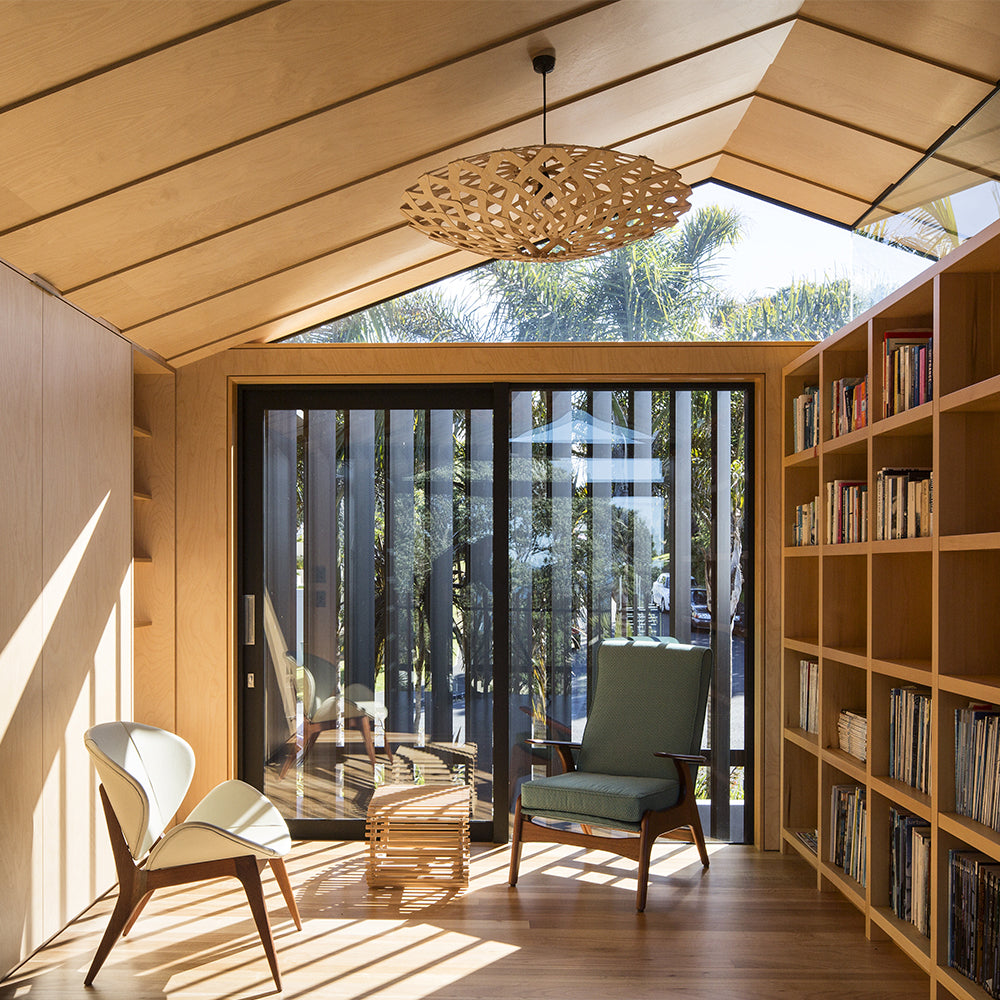
We make Floral from sustainably grown, EPD-certified bamboo and send it flat-packed as a kitset. As a certified B Corp, we put care into how the light is made and packed; for your room, measure the assembled form rather than the box it arrives in.
Make a full-size mockup
- Write down the chosen shade's maximum width and total height.
- Cut a paper or cardboard outline to those dimensions. Keep this separate from the electrical fitting.
- Have someone hold the outline at the proposed position, or use a clear photograph with measured reference points.
- Look from the doorway, the usual seats and the adjoining room. Check windows, doors and sightlines.
- Repeat with the next size or a different shape. Photograph both from the same positions.
A flat outline cannot show every detail, but it makes scale much easier to judge. For an open shade, remember that you will see through parts of the real form. The mockup may look visually heavier than the finished light.
Include the height and suspension
Above a dining table or counter, start by testing a bottom edge around 800 to 900 mm above the surface. Add the shade's height to find its top edge. What remains between that point and the ceiling must accommodate the suspension and connection.
Our pendant light height guide shows the calculation in full. For circulation spaces and stairwells, ask your installer to assess the relevant clearance rather than applying the table rule.
Size a group as one composition
For two or more pendants, draw every shade at its real width. The total composition includes the gaps, not just the sum of the shades. Check the space between their edges, their relationship to the surface below and their overlap when viewed from the side.
Do not multiply the single-shade table proportion by the number of fittings. Start again with the complete arrangement. Our rows and clusters guide helps compare repeated and mixed forms.
Keep brightness as a separate decision
A larger shade does not by itself supply more useful light. Bulb output, shade construction, distance and the other light sources in the room all matter. Choose the form and the lighting role together, especially where the room includes reading or food preparation.
Compare the pendant lighting collection with your full-size outlines. The sizing proportions here are recommendations that depend on the room; we can help with a free render visualisation using your exact measurements.
Your questions
What if my table measurement falls between pendant sizes?
Test both nearby sizes in the room. The shape, openness, ceiling height and view around the shade can matter more than landing on an exact fraction.
Can I use the table-width rule for a hallway?
No table anchors the fitting in a hallway. Assess the room's width, circulation, doors and available clearance with your installer instead.