Pendant Light Height: Tables, Islands and Open Spaces
Measure pendant light height from the surface it belongs to, then account for the whole fitting. The bottom of the shade, the top of the shade and the ceiling connection each have a place in the calculation.
Pendant light height above a table
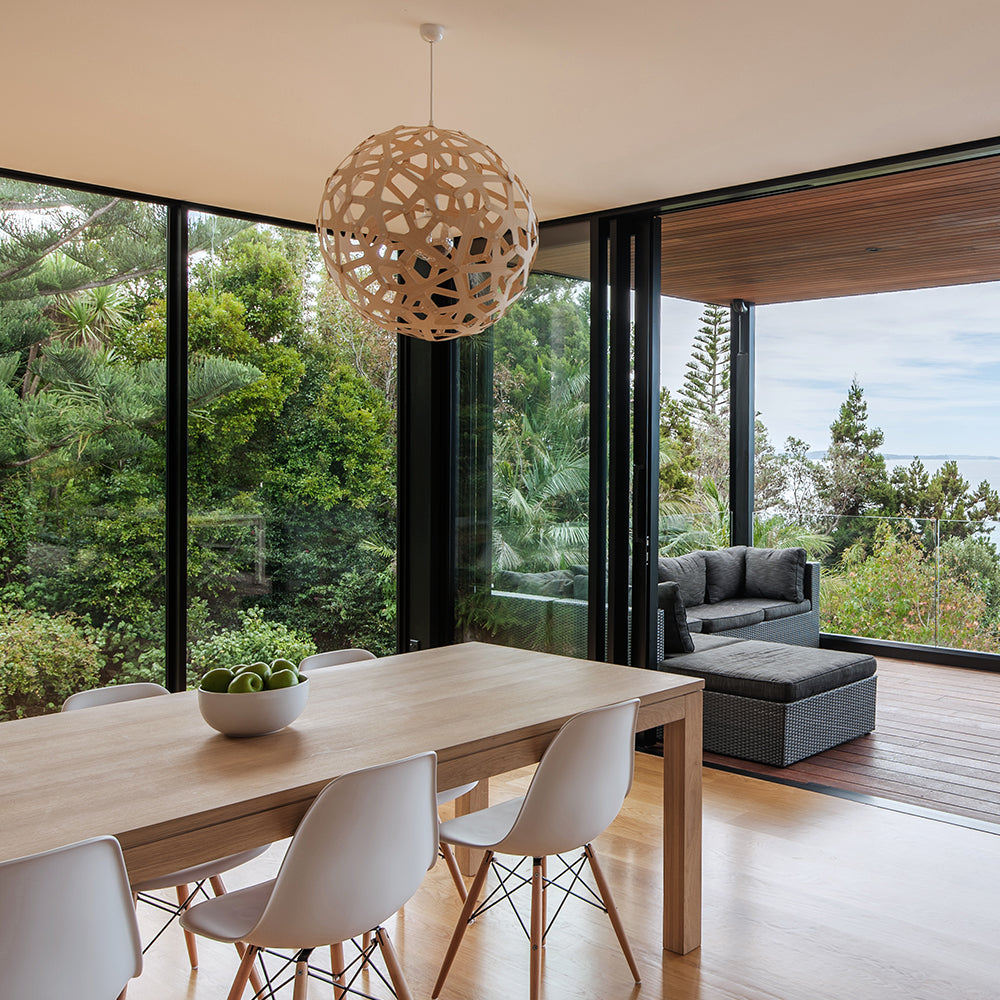
We suggest starting around 800 to 900 mm above the tabletop, measured to the lowest point of the shade. Sit at the table and check the view of the person opposite. Then look from the doorway and adjoining spaces. Adjust the proposed position around the fitting, the room and the people who use it.
This is a design starting point for a table, not a universal installation clearance. Our guide to choosing pendant lights connects height with purpose, scale and the character of the light.
Calculate the whole drop
Use one unit throughout. Write down the ceiling height from the floor, the surface height, the desired gap above that surface and the fitting's total height. The difference tells you the space remaining above the shade.
| Measurement | Example |
|---|---|
| Floor to ceiling | 2700 mm |
| Floor to tabletop | 750 mm |
| Tabletop to bottom of shade | 850 mm |
| Shade height | 600 mm |
| Top of shade above floor | 750 + 850 + 600 = 2200 mm |
| Space above shade | 2700 − 2200 = 500 mm |
In this example, 500 mm remains for the suspension and ceiling connection. It is not automatically the cable length to order: the ceiling hardware and the fitting's attachment details also take space. Give the calculation to your installer with the product drawing.
With the same table and gap under a 2400 mm ceiling, only 200 mm would remain above that 600 mm shade. That is why it helps to compare a shallower form rather than simply shortening a cable after purchase.
Pendant light height above an island
The same starting gap of around 800 to 900 mm can help you test a pendant above a counter. Measure from the counter surface, not from the floor. A higher counter changes the shade's position in the room even when the gap is unchanged.
Check the view while standing at the preparation area and while sitting on a stool. Include taps, extractors, cupboards and the view through an open-plan kitchen. Our kitchen-island pendant selection also separates decorative lighting from the task lighting needed at the work surface.
Let the shade's proportions do some of the work
A shallow shade may give you a broad visual presence without using the vertical space of a sphere or elongated form. Flax 800, for example, is 220 mm high. Hīnaki 900 is 900 mm high. Each needs its own drop calculation.
Use our size guide to compare the outline as well as the suspension. If the calculation leaves very little space above the fitting, reconsider the shape and position before ordering.
Hīnaki began with David's first light prototype in 1995, inspired by woven fish traps. Its long outline is part of that story, so give the form enough height to be appreciated as a whole.
Open floors and stairs need a different check
A table keeps people from walking directly under much of the fitting. A hallway, entrance or stairwell does not. Assess the full route, door movement and nearby levels with the installer; do not use the dining-table gap to decide a circulation clearance.
In a stairwell, include a section drawing showing the landings and steps. Check access for cleaning and changing the bulb at the same time. These decisions are much easier before the position is fixed.
Test the final position before committing
- Mark the intended table or island position on the floor plan.
- Use a paper outline to represent the whole shade at the proposed height.
- Check seated and standing sightlines, doors and nearby surfaces.
- Record the dimensions and take photographs from the usual viewpoints.
- Have a qualified electrician confirm the suspension, support and electrical installation.
These hanging-height and clearance recommendations depend on your space. Our free render visualisations use your exact room measurements to help compare forms, while your installer confirms the final suspension and safe clearances.
Your questions
Is hanging height measured to the bulb or the shade?
For the design starting point above a table or counter, measure to the lowest part of the shade. Include the full fitting and hardware when calculating the space above it.
Should all pendants in a row hang at the same height?
A level row creates a calm rhythm, while different drops create another composition. Decide deliberately and test the whole arrangement from the side as well as the front.