Pendant Lights for a Living Room
The living room asks a light to live with many different moments. A pendant can hold the room together as a sculptural form, while smaller, more focused lights support reading, conversation and everyday movement.
Explore three living-room forms
 Explore CoralSizes 400 to 1600 mm
 Explore CloudSmall 1250 mm wide, or Large
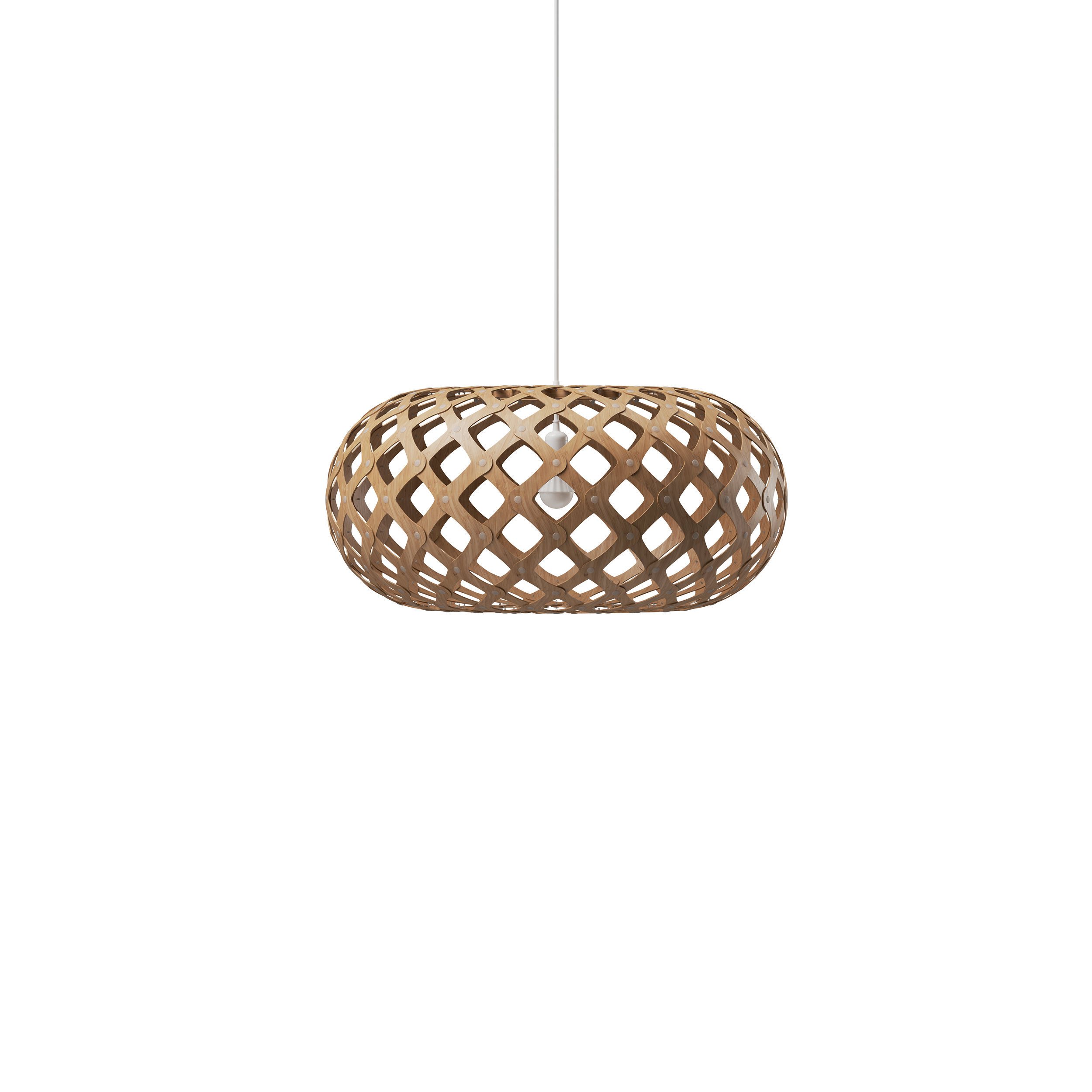 Explore KinaSizes 440 to 1400 mm
Coral gives a room a rounded, open structure. Its pattern becomes part of the evening view, so consider nearby surfaces as well as the shade itself. Cloud has a broader, irregular presence. Cloud Small is 1250 mm wide, 1250 mm long and 450 mm high, a generous footprint to test against the seating area.
For a long, narrower composition, consider Navicula Small: 570 mm wide, 1440 mm long and 200 mm high. Its soft upward glow makes it a sculptural feature; keep separate light for reading.
Kina offers a rounded bamboo form inspired by a sea urchin shell. Choose from widths of 440, 600, 800, 1000 and 1400 mm, with respective heights of 200, 280, 370, 420 and 650 mm. Its shallow, open shape gives you a different way to centre a seating area.
Place the light around the way you live
Start with the seating arrangement. In a large open room, a pendant can give one group of chairs its own centre without trying to light the whole floor plan. In a smaller lounge, check its relationship with the sofa, television and doors before using the ceiling centre as the default position.
Our guide to choosing pendant lights begins with purpose. Here, ask whether the light should draw attention, quietly connect the furniture or bring a pattern to an otherwise plain wall.
Our kitset approach lets a generous form begin as a small, flat package. As you assemble the pieces, the room's new centre takes shape in your hands.
Living room pendant lighting: scale in three dimensions
A wide room does not automatically need the largest shade. The furniture grouping, ceiling height and views through the room all affect how a light feels. Measure the proposed diameter and height, then make a simple full-size outline. Look at it from the main seats as well as the entrance.
Our pendant light size guide explains the mockup process. For a ceiling with generous height, test the drop too: a fitting held too close to the ceiling can feel detached from the furniture, while a low form may interrupt movement or views.
Lounge pendant lights and the other layers
A pendant does not need to carry every lighting task. Keep a reading light close to a favourite chair, and consider how light reaches the room's darker corners. This can let the central fitting remain part of the atmosphere instead of becoming an overly bright source.
Read our comparison of ambient and task lighting if you are deciding what each fitting should do. Test the room with the television on as well as off: reflections and a visible bulb can matter more from a seated position than from a standing one.
Let the evening pattern guide the bulb
With an open patterned shade, the bulb and the distance to nearby surfaces help determine the shadows. A clear source can create a crisper pattern; more diffuse light softens it. Our clear and frosted bulb comparison shows what to consider.
Bring together the colour temperatures of the lights you use at the same time. They do not have to be identical everywhere, but a deliberate choice feels more coherent than a mixture chosen one bulb at a time.
Choose a form for the way you gather in our pendant lighting collection. These sizing and placement recommendations depend on your space; let us show the options in a free render visualisation using your exact measurements.
Your questions
Should the pendant sit over the coffee table?
It can help centre a seating group, but check the whole room and circulation routes. The best position depends on the furniture arrangement and the fitting's dimensions.
Will a larger shade make the lounge brighter?
Shade size and light output are different things. Compare the bulb's lumens, the shade's construction and the room's other lights as well as its diameter.