Pendant Light vs Chandelier: Which Suits Your Space?
A pendant is a suspended light; a chandelier usually brings several light sources together in one fixture. The most useful choice is not a label, but the form, distribution of light and scale your room needs. We start with how you want to live beneath the light.
The difference between pendant and chandelier
A single pendant commonly hangs from one cable, rod or chain and holds one light source within or beside a shade. A chandelier usually supports multiple sources on branches or a shared structure. Contemporary designs blur that boundary: a group of pendants can create the presence people associate with a chandelier.
Neither category determines the style by itself. Pendants can be visually generous, and chandeliers can be restrained. Our guide to choosing pendant lights starts with the room and the light's purpose rather than a fixed style rule.
| Decision | Single pendant | Chandelier or grouped lights |
|---|---|---|
| Visual centre | One clear form | A composition of several sources or elements |
| Footprint | Defined mainly by one shade | Includes the whole structure and spaces between elements |
| Light distribution | Depends on bulb, shade and position | Depends on each source and the way the group spreads them |
| Maintenance | Access to one fitting and its source | Access to every element and source |
| Installation planning | Confirm support, connection and drop | Also confirm complete weight, layout and connection arrangement |
Pendant light vs chandelier over a dining table
One generous form can centre a round table. A longer structure or row can relate to a rectangular table's length. Start with the table and the view across it, then compare the full outline of each option. Several small elements may take more visual space than one larger open shade.
Our dining-table pendant selection looks at rounded and shallow forms. If you prefer a group, draw every shade at its actual width and include the gaps. A photograph of a fitting on its own cannot show how it will sit over your table.
Scale and ceiling height
A chandelier is not automatically too large for a smaller room, and a pendant is not automatically compact. Measure the complete width and height, including decorative parts that sit beyond the bulbs. Then calculate the space for suspension above it.
Our height guide shows why the shade's height matters. A broad, shallow Flax and a tall Hīnaki require different amounts of vertical space. In an entrance or stairwell, have the installer assess circulation and access alongside appearance.
Compare the light, not the bulb count
Several bulbs do not automatically make a fitting the right light for a task. Their output, direction, diffusion and position all matter. A decorative fitting can create atmosphere while another source provides focused light for reading or preparation.
An open patterned shade adds another consideration: the shadows it casts. A clear source may bring those patterns into focus. A more diffuse source changes their edge and presence. Think about the surrounding walls and ceiling, not just the object itself.
A cluster as a third option
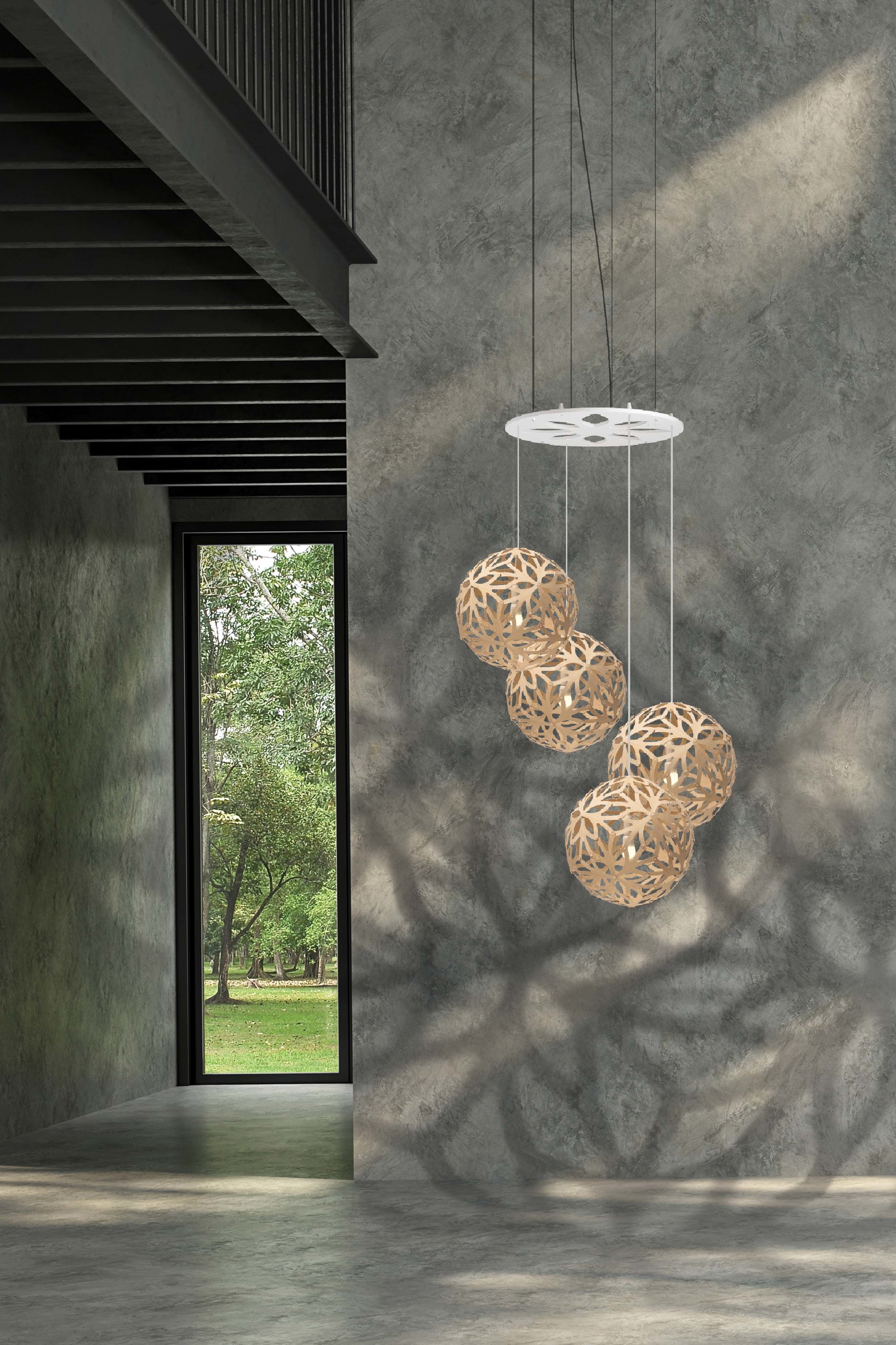
If you want several forms within one composition, explore multiple pendant lights. Repeated shapes create rhythm; different drops let a tall space hold a more varied arrangement.
Our Cascade Top is designed for specified small Coral, Floral, Kina, Kōura and Hīnaki models. Lights are sold separately. It gives a defined starting point for a cluster, while the final model selection, support and installation still need to be planned.
Our flat-packed kitsets offer another part of the experience: each shade takes shape through assembly before the group is installed. Allow time and a clear work surface for every light in the composition.
Chandelier vs pendant: which should you choose?
Let the room decide. These starting points narrow the choice before you draw anything.
- Choose a single pendant when one table, island or seating area needs a clear centre, when the ceiling is modest, or when you want one form and its shadow pattern to carry the room.
- Choose a chandelier or a grouped fitting when a large, tall space needs a presence that spreads across a wider area, and there is height for the complete structure and a way to reach every source.
- Choose a cluster of pendants when you want a chandelier's sense of occasion built from individual forms, with drops you can vary for a stairwell or double-height void.
In many homes the answer is a pendant over the place people gather, with other light where the tasks happen. If the room asks for more presence, a cluster lets you build it one shade at a time.
Make the choice in the room
Compare a full-size outline of one fitting with a drawing of the complete group. View both from the entrance, the usual seats and any upper level. Note the installation needs and how every light source will be reached later.
Explore our pendant lighting collection for a single form or the beginning of a group. These scale and placement recommendations depend on the space; compare the composition in a free render visualisation using your exact measurements.
Your questions
Is a chandelier always brighter than a pendant?
No. Compare the rated light output and distribution of the complete arrangement, rather than counting bulbs or judging the fitting's size.
Can I mix a chandelier and pendants in one open room?
Yes, a shared material, colour or proportion can connect different forms. Check them together from the main viewpoints so each has a clear role.